Interview: Norwegian Refugee Council - CHS certification does most of the heavy lifting
Interview with Norwegian Refugee Council - CHS certification does most of the heavy lifting
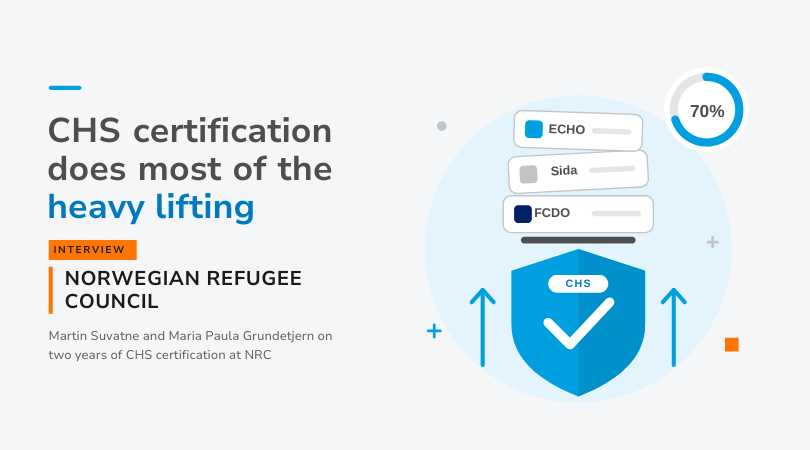
Norwegian Refugee Council’s CHS certification has delivered value far beyond compliance. From reducing repetitive donor due diligence assessments to profound organisational learning, the process has become a practical tool for improving accountability and programme quality.
Maria Paula Grundetjern, Administration and Communications Coordinator, and Martin Suvatne, Director of Institutional Partnerships at NRC, shares their thoughts after two years of CHS certification.
Martin, let’s dive directly into a trending topic: How has CHS certification helped NRC with donor due diligence?
One example is our work with FCDO where the passporting has reduced the need for repeated country-level assessments, reinforcing the value of independent assurance. The CHS did 70% of the job when it came to demonstrating our organisational systems and assurance mechanisms, giving us a strong platform from which to engage.
The value extends well beyond a single donor. With Sida, CHS certification featured prominently throughout NRC’s successful selection as a strategic humanitarian partner for 2026-2029 and is referenced 12 times in our latest organisational application. With ECHO, CHS is explicitly identified as one of the standards used to establish DG ECHO's quality requirements and evaluation criteria. We will use our CHS certification and the related documentation for upcoming donor accreditation.
"The CHS did 70% of the job when it came to demonstrating our organisational systems and assurance mechanisms, giving us a strong platform from which to engage."
Maria Paula in your judgment what has been the biggest learning from the certification process?
For NRC, accountability to affected populations is non-negotiable. That commitment was one of the key reasons for pursuing CHS certification in the first place, and one of the biggest lessons has been the value of having an independent organisation test how well we are living up to that commitment in practice.
The strength of the process lies in the rigour of the external assessment. During the initial audit, HQAI interviewed 146 NRC employees, 192 community members and 32 partners, providing a level of triangulation and evidence-gathering that few internal or external reviews could achieve. Regular follow-up, action plans and reporting further help organisations prioritise improvements, maintain focus during periods of restructuring and secure buy-in for quality and accountability initiatives.
As one colleague reflected, “we needed that wake-up call”. The audit provided the right push to address some issues more systematically, rather than relying on perceptions or good intentions. In many cases, the findings confirmed what teams already suspected, but the independence of the process helped maintain momentum, strengthen buy-in and turn priorities into action. The value of CHS certification is not the certification itself, but what it prompts an organisation to do.
The second big learning is how the process encouraged a more intentional and systematic effort towards strengthened quality and accountability. Strong policies alone are not enough. We also need to ensure they are consistently implemented, documented and experienced by the people and partners we serve.
“The value of CHS certification is not the certification itself, but what it prompts an organisation to do.”
How can the sector get the maximum value from the CHS and independent audits, Martin?
For NRC, one of the key benefits of CHS is its potential to become a widely recognised reference point for accountability in the humanitarian sector. It creates momentum for change.
The CHS provides an independently verified framework that gives donors confidence that an organisation’s systems, policies and practices have already been rigorously scrutinised.
Looking ahead, great potential value lies in reducing duplication. If more donors accept CHS certification as evidence of organisational quality, accountability and safeguarding systems, organisations could spend less time responding to repeated due-diligence requests and more time delivering programmes.
As a result, CHS can become more than a standard. It can become a shared assurance mechanism that reduces administrative burden for both donors and NGOs while strengthening accountability across the humanitarian sector.
Ultimately, the real value of CHS is not the certificate on the wall. It is the independent scrutiny, organisational learning and continuous improvement that follow.
Donor recognition is important, but the true value of CHS emerges when certification extends across the sector, including to local organizations. Broad adoption enables CHS to serve as a shared framework that strengthens work in consortia and partnerships across the sector.
"For NRC, one of the key benefits of CHS is its potential to become a widely recognised reference point for accountability in the humanitarian sector. It creates momentum for change."
Maria Paula and Martin, we thank you for this conversation.
Category