From Organisational Learning to Recognition
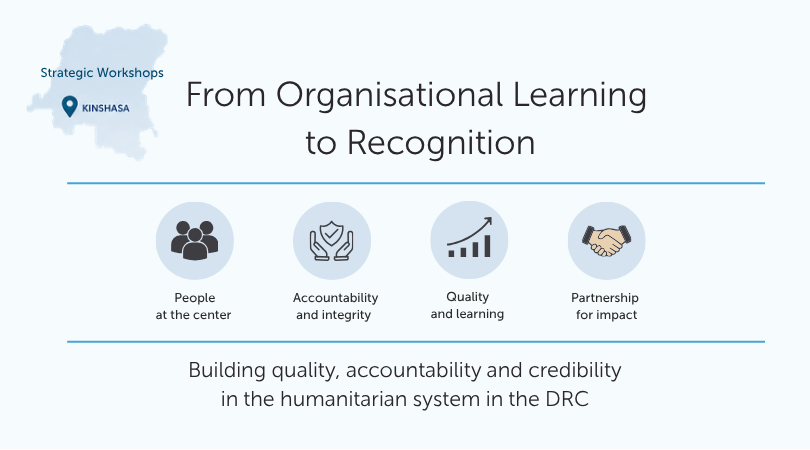
From Organisational Learning to Recognition: ECC-DRC Project Concludes with Strategic Workshops in Kinshasa
The Enhancing the Capacity and Credibility of NGOs in the DRC in Meeting Quality and Accountability Standards (ECC-DRC) project successfully concluded this month, marking a significant milestone for national organisations striving for greater recognition within the humanitarian system. Implemented over six months by HQAI and the CHS Alliance, in close collaboration with CONAFOHD and funded by the H2H Network with support from FCDO, the initiative combined CHS learning, Self-Assessment and Audit Readiness pathways with organisational learning and advocacy.
The project’s final week featured two pivotal events: a strategic dialogue in Kinshasa bringing together donors, UN agencies, national and international NGOs, and an online reflection session for organisations engaged in the Audit Readiness pathway. Both gatherings underscored a shared conviction: that strengthening organisational systems creates immediate value and trust, even before an external audit takes place.
“We understood that quality is not only about the activities carried out. It is also about how an organisation functions, makes decisions, listens to communities and involves them.”
Throughout the strategic dialogue, the narrative shifted from viewing external quality assurance as a mere compliance checkbox to recognising it as a cornerstone of organisational credibility. CONAFOHD highlighted its strategy for professionalising national NGOs through regular self-evaluation, visibility and investment in organisational capacity. This vision was echoed by participants who noted that robust organisational systems are the foundation upon which recognition is built, rather than simply a byproduct of external assessment. As one participant confirmed, the process revealed that quality is not just about field activities, but fundamentally about how an organisation functions, makes decisions, and genuinely involves the communities it serves. This realisation has already prompted several organisations to develop new roadmaps for integrating the CHS into their daily operations.
“The process does not only generate an external assessment but supports organisations to understand and take ownership of their own development priorities.”
The experience shared by those in the Audit Readiness pathway further illustrated this transformative journey. By systematically reviewing governance, safeguarding, programme management, and human resources, organisations were able to identify gaps and prioritise improvements on their own terms. Participants described the diagnostic process as empowering, allowing them to take ownership of their development priorities before seeking external validation. One attendee noted that the tools provided enabled their team to spot internal weaknesses independently, turning the Audit Readiness into a constructive guide for future growth. This distinction between learning and independent assurance remains central to the project’s legacy: Audit Readiness does not demonstrate conformity with the CHS, nor does it replace an independent audit. Its contribution lies in helping organisations understand and strengthen their systems before deciding on certification.
“Structural costs, organisational systems and audit processes should be eligible within capacity-strengthening budgets.”
Looking ahead, the conversations initiated in Kinshasa have paved the way for broader changes in how capacity strengthening is financed and recognised. During the Kinshasa workshop, participants explored how evidence generated through CHS verification could be better recognised by donors and international partners. The concept of "passporting" evidence (i.e. where existing independent assessments are used to reduce duplication in due diligence) gained traction as a practical solution for streamlining partnerships. Further, there is a growing consensus that investment in organisational systems (governance, accountability, safeguarding, financial management, etc.) and related audit processes should be viewed as essential development costs, rather than additional compliance expenses.
As the ECC-DRC project closes, its impact endures: participating organisations are better equipped, more self-aware, and prepared to continue their journey toward credible recognition in the global aid arena.
Category